01The Tree That Made a Town
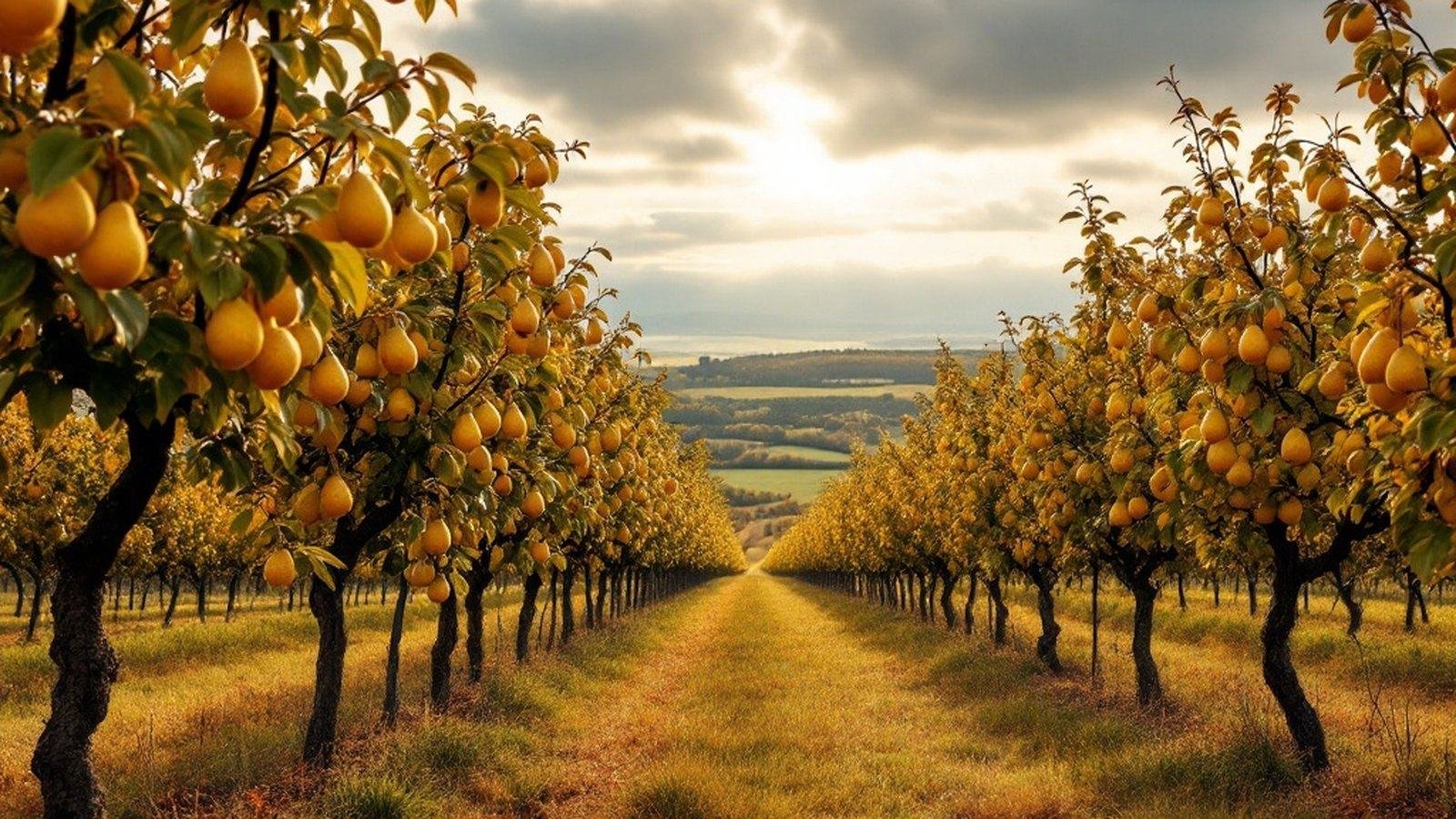
There is a pear tree in the Passais that may be two hundred years old. It stands in a hedgerow field south of Domfront, its trunk the width of a man's armspan, its crown broad enough to shelter a small flock. In autumn, the ground beneath it is carpeted with small, hard fruits — not the kind you would ever eat out of hand, bitter and tannic with a fibrous grip — but the kind that, pressed and fermented slowly over winter, produce something extraordinary: poiré, a pear perry of startling refinement, pale as straw, faintly sparkling, and carrying within it the mineral cool of the bocage.
This is not a novelty drink or a recent revival act. Pear trees have been cultivated in the Passais, the deep countryside that rolls south and west of Domfront, since the medieval period.1 The region's granite soils and humid, temperate climate turned out to be ideal for the long-lived varieties of poiré pear that produce no worthwhile eating fruit but yield juice of remarkable complexity. By the seventeenth and eighteenth centuries, the orchards of the Domfront country were famous far beyond Normandy — the drink was traded into the cities, prized at noble tables, considered a luxury by those who knew it.
Then came the long decline. Orchards were grubbed up, grazing became more profitable than fruit trees, and the varieties dwindled. Poiré retreated from wider commerce into local habit, then into near-invisibility. For much of the twentieth century it was what a farmer made for family and neighbours, not something you would find outside the département.
What saved it — or at least gave it a framework for survival — was the designation that now defines the drink: the AOC, awarded in 2002, which enshrined the pears, the place and the method in protected law. Poiré de Domfront became one of the handful of Norman drinks to carry a French appellation, sitting alongside the great Calvados designations. The production zone is tightly drawn around a cluster of communes in the southern Orne, with Domfront-en-Poiraie — the town's own full name embedding the perry in its identity — at its heart. If it doesn't come from here, it isn't Poiré de Domfront.
- The medieval periodPear cultivation established across the Passais bocage on its granite soils.
- 17th–18th centuriesThe orchards of the Domfront country grow famous; poiré traded into the cities and prized at noble tables.
- The twentieth centuryLong decline — orchards grubbed up for grazing; poiré retreats into local, near-invisible habit.
- 2002The AOC enshrines the pears, the place and the method in protected law.
- The past fifteen yearsA quiet revival and replanting; younger trees go into the ground across the Passais.
02The Orchard and the Press
To understand the drink, it helps to understand the tree. Standard poiré pears are not planted in the tight rows of a modern orchard. They are grown as hautes-tiges — high-stemmed standards — standing wide apart in permanent grassland, their canopies reaching well above any apple tree, their roots deep in the granite-clay mix that gives the juice its edge. They are slow to establish, and they live long: specimens of a hundred and fifty years are not uncommon in the old farms of the Passais, simultaneously working trees and pieces of landscape architecture.
Harvest comes in autumn, later than apple cider. The small fruits fall naturally or are collected from the ground over several weeks, and their timing matters — over-ripe pears ferment erratically. At the press, the fruit is pulped and the juice extracted; the juice is dense and cloudy, tannin-rich in ways that the palate notices immediately.
Then comes the fermentation — and here is where poiré becomes genuinely difficult to make well.
Pear juice is less stable than apple juice: it ferments faster, its sugars behave less predictably, and the resulting drink is more volatile. The AOC sets minimum standards, but the skill of the cidriculteur in managing that fermentation is what separates a bottle of true finesse from an average one. The finest examples are fermented slowly in tank through the winter cold, bottled before fermentation is complete — the traditional méthode de prise de mousse en bouteille — and arrive in the glass with a gentle sparkle and a residual sweetness that never tips into cloying.2
| Variety | Role in the blend | Character it lends |
|---|---|---|
| Plant de Blanc | Principal authorised variety | Backbone; finesse and aromatic lift |
| Plant de Mayenne | Supporting variety | Structure and body |
| Fausset | Supporting variety | Tannin and grip |
| Rouge Vert | Supporting variety | Colour and depth |
| Gros Lodon | Supporting variety | Yield and roundness |
The result, at its best, is one of France's most underrated drinks. It has the freshness of a good pét-nat, the mineral authority of a northern wine, and a flavour profile that resists easy comparison: pear, yes, but also something floral and faintly earthy, with a long finish that the tannins — unusual in a perry — support and extend.
03Finding It, Tasting It
The quiet revival the drink has been undergoing is less a marketing campaign than a slow reclamation by the producers who stayed with it. A modest number of farms make Poiré de Domfront under the AOC — the production remains artisanal in scale, and some of the best makers are farms where perry is one part of a broader enterprise of cider, Calvados and direct farm sales.
For a visitor, the most direct way to find the drink is to follow it to its source. The poiré and cider route through the Passais threads through the countryside around Domfront, connecting farm cellars and producers who welcome visitors. This is not a polished wine-route experience; you will often be met by the person who made the drink, shown the press, and poured a glass in a barn.
At the farm gate These are working farms, not visitor centres. Ring ahead where a number is given, take your time, and buy a bottle if you've been shown around — a producer who feels respected keeps the door open.
Poiré sits within a wider Norman glass. To place it, a rough guide to strength puts it at the gentle end — closer to a sparkling wine than to the spirits its orchards also yield.
04Why It Matters Here
The name Domfront-en-Poiraie is not an accident of tourism branding. Poiraie is an old Norman word for a pear orchard, and the town wore this landscape into its identity long before any appellation existed. The standard trees still visible in the field patterns around the town are not decoration — they are working agriculture, continuous with a tradition that is centuries deep.3
When you drink a glass of well-made Poiré de Domfront — really drink it, cold and unhurried, somewhere with a view of the valley — you are tasting a specific place as precisely as any grand cru wine. The fruit grew here. The water that fed the trees came from this granite watershed. The fermentation happened in a farm a few kilometres from where you are standing. It is as rooted as a drink can be, and in a world of blended, de-localised beverages, that rootedness is itself worth something.
The perry revival is modest and undramatic, which suits it. This has never been a drink that shouts. It finds its admirers quietly, in good company, with food that doesn't overwhelm it — a plate of local cheeses, perhaps, or the andouille that the Passais does so well — or simply on its own, on a warm afternoon in a town that put the pear orchard in its very name. Taste it once and you will understand why Domfront kept it.